
Fairfax Court Records After Arrest
After a Fairfax jail arrest, the Adult Detention Center handles custody, booking, classification, release, and hold status. The court system handles formal charge records. Those two paths overlap, but they are not the same record. A booking entry can reflect the arresting officer's initial charge, while the later court case may show an amended charge, a reduced count, a dismissed count, or a felony indictment.
The Office of the Fairfax Commonwealth's Attorney prosecutes misdemeanor, felony, delinquency, traffic, county ordinance, and state statute matters committed in Fairfax County. For custody and booking details, use Fairfax County jail inmate records. For booking photos, use the separate Fairfax County jail mugshots process. The court record is the place to check the filed charge, next court date, bond event, disposition, and whether the case remains open.
Fairfax Court Case Search
Fairfax Circuit Court eCaseSearch is the key local portal for public circuit criminal case-index information. It is free and covers non-confidential Circuit Court case index records from October 18, 2004. The portal does not provide case documents, and sealed cases are omitted from public display. Felony matters, misdemeanor appeals, and some criminal or traffic appeal files can belong in Circuit Court, while misdemeanor and traffic cases commonly appear in General District Court.
The Fairfax Circuit Court eCaseSearch screen is included because it is the local case-index tool most tied to Fairfax County court records after a jail arrest.
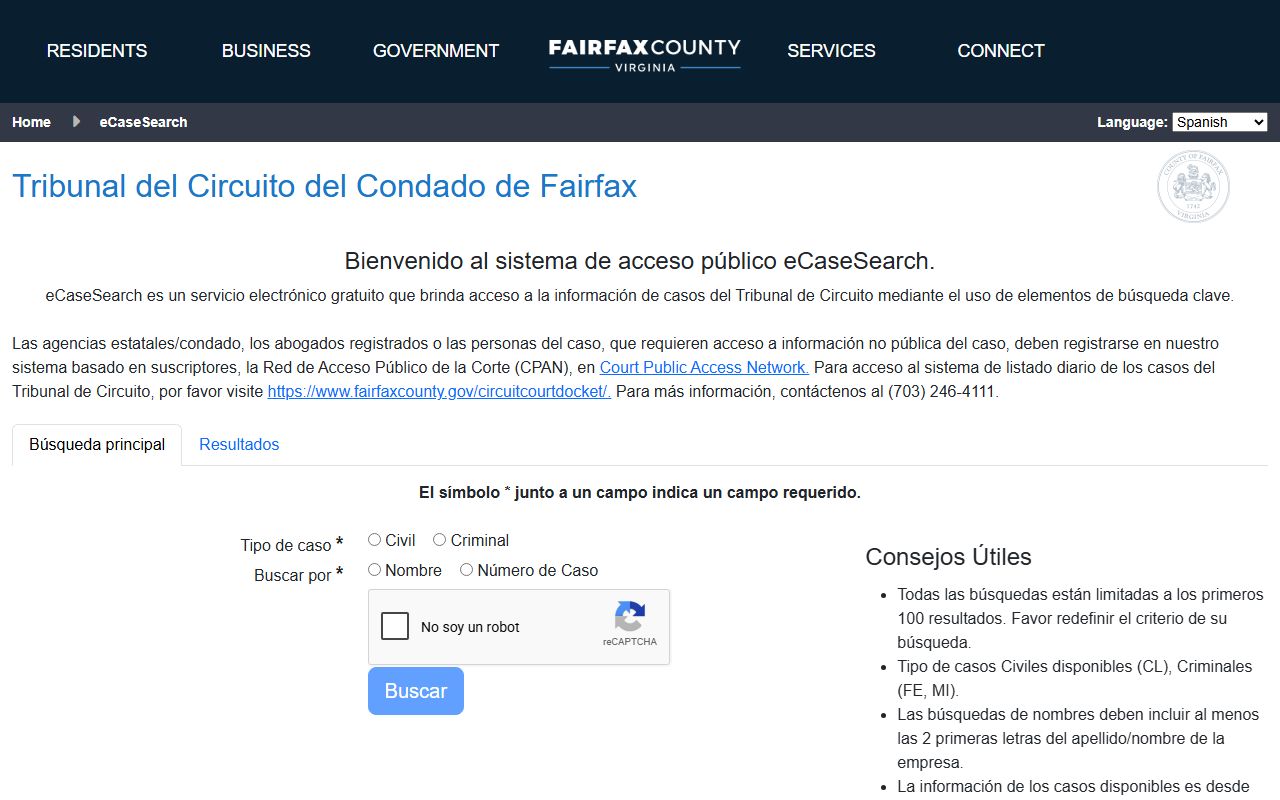
The search results are only an index. If the docket points to a current criminal file, Fairfax Circuit Court says current criminal files are generally available for review in the Criminal Division on the courthouse fourth floor.
| Field | Type | Required | Notes |
|---|---|---|---|
| Language | Option links | No | English, Spanish, Arabic, Korean, Amharic, Chinese, and Vietnamese are listed. |
| Case Type | Radio button | Yes | Select Civil or Criminal. Arrest-related cases use Criminal. |
| Search By | Radio button | Yes | Search by Party Name or Case Number. |
| Case Number | Text | If used | Criminal case prefixes include FE and MI; civil cases use CL. |
| Last Name or Company | Text | For name search | At least the first 2 letters are required. |
| First Name | Text | No | Useful for narrowing common names. |
| Results | Table | N/A | Searches are limited to 100 results; click the case number for details. |
The Virginia Courts General District Court Case Information system is the official route for many misdemeanor and traffic records. The statewide case-status hub says General District Court cases can be searched by name, case number, or hearing date. Access may pause during maintenance windows, and the portal was observed with a notice that it was unavailable from 4:00 AM to 1:00 PM EST during research.
Arrest to Fairfax Court Record
The court path after a Fairfax County jail arrest usually starts with arrest and booking, then moves to magistrate or court review of custody and bond. Misdemeanor and traffic cases often proceed in Fairfax General District Court. Felony cases may begin in a lower court and later move to Fairfax Circuit Court after certification, indictment, or another felony filing step. The Commonwealth's Attorney can file, amend, reduce, dismiss, or seek indictment on charges as the case develops.
- Confirm whether the person was booked into Fairfax County Adult Detention Center or another system.
- Check the proper court portal by name or case number after the case is entered.
- Read each charge line separately because one arrest can produce several counts.
- Compare the charge status with bond, next hearing, warrant, and disposition entries.
- Contact the clerk or Criminal Division if the public portal omits a file that should be public.
Fairfax Circuit Court Criminal Division is located at 4110 Chain Bridge Road, Courthouse Suite 409 and 409.1, Fairfax, VA 22030. The Criminal Division phone number is 703-246-2228, and office hours are 8:00 AM to 4:00 PM Monday through Friday. General District criminal records are generally retained for 10 years from judgment or conviction. Criminal sexual offense records are retained for 50 years.
Fairfax Arrest Charging Documents
A charging document is the paper or filing that starts or advances a criminal charge in court. It is not the same as a jail booking entry. In Fairfax County court records after an arrest, the key question is who filed the charge and what court has the case. That distinction helps explain why a jail charge can look different from the court charge that later appears in eCaseSearch or General District Court records.
| Document | Who Uses It | Common Role | Record Impact |
|---|---|---|---|
| Complaint or warrant | Officer, magistrate, or prosecutor path | Starts many lower-court criminal matters after arrest. | May be tied to initial custody, bond, or first appearance. |
| Information | Prosecutor | Prosecutor-filed charging document in some felony contexts. | Can replace or refine earlier arrest-based charges. |
| Indictment | Grand jury | Grand-jury felony charging document. | Often moves or anchors a felony in Circuit Court. |
The Fairfax Commonwealth's Attorney, Steve T. Descano, leads the office at 4110 Chain Bridge Road, Suite 114, Fairfax, VA 22030. The office phone number is 703-246-2776, and its public hours are 8:00 AM to 5:00 PM Monday through Friday. A 2026 DOJ press release announced an investigation into the office's charging, plea, and sentencing policies, but the release stated that no conclusions had been reached.
Fairfax Charge Status Table
Charge status matters because a court record is not frozen at the moment of arrest. Prosecutors and courts can alter the legal path. A charge may stay pending, be amended, be reduced, be dismissed, be nolle prossed, or end in conviction. Each status should be read at the count level, not just at the case level.
| Status | Meaning in a Fairfax court record |
|---|---|
| Pending | The case or charge is still open and has not reached final disposition. |
| Amended | The charge changed from the earlier wording, code section, or count. |
| Reduced | A lesser charge replaced or changed the original charge. |
| Dismissed | The charge ended without a conviction on that count. |
| Nolle prosequi | The prosecutor declined to proceed on that charge. |
| Conviction | The charge ended in a guilty finding or plea. It is not the same as arrest. |
Bond Warrants and Holds
Virginia release terms include recognizance, unsecured bond, secured bond, and no-bond custody. Fairfax Sheriff's pages do not publish a complete bond payment manual, so current bond-posting instructions should be confirmed through the Adult Detention Center, the court record, the magistrate or clerk, or a licensed Virginia bail bondsman. A detainer or hold from another agency can block release even when local bond is posted.
| Bond or hold term | Plain meaning | Fairfax record note |
|---|---|---|
| Recognizance or PR | Release based on a promise to appear and follow conditions. | Confirm through court, magistrate, or ADC because no public jail bond table exists. |
| Cash or secured bond | Money or security is required before release. | Call ADC for the current payment route and release conditions. |
| Surety bond | A licensed bail bondsman posts bond under Virginia rules. | Inmates may make official local calls to bonding agents after classification. |
| No-bond hold | Release is not available until a court changes the status or a hold clears. | Serious charges, probation matters, or outside warrants can create this status. |
No official Fairfax public active criminal warrant search was located. The Sheriff's Warrant Desk is the direct local channel for warrant questions at 703-246-4231. The Sheriff's Civil Process Search is different. It searches civil process records for Fairfax General District Court cases, not active criminal warrants. Sheriff's scam notices also warn that the office will not call and demand money, gift cards, or electronic payment to clear a warrant.
Charges Versus Convictions
An arrest charge is an accusation. A conviction is a final court outcome based on a plea or finding of guilt. That gap matters when reading Fairfax County court records after a jail arrest, especially where several charges appear at intake and only some charges remain after review by the Commonwealth's Attorney or the court.
| Issue | Charge | Conviction |
|---|---|---|
| Stage | Accusation filed after arrest or by later charging document. | Final guilty finding or plea on a specific count. |
| Proof level | Can begin with probable cause or charging authority. | Requires proof beyond a reasonable doubt or a valid plea. |
| Record meaning | Shows what was alleged and tracked in court. | Shows the final guilty outcome for that charge. |
| Risk of confusion | May be amended, dismissed, or nolle prossed. | Should be read with sentence, appeal, and expungement context. |
Sealed Expunged Fairfax Records
Public portals do not show every court record. eCaseSearch omits sealed cases, and Virginia law treats juvenile, confidential, investigative, and certain protected records differently from ordinary public docket information. Expungement is a separate legal process under Virginia Code § 19.2-392.2 for eligible police and court records when statutory criteria are met.
| Issue | Sealed record | Expunged record |
|---|---|---|
| Public portal access | Hidden or omitted from public case display. | Removed from ordinary public access after a qualifying court process. |
| Legal basis | Usually tied to court confidentiality or sealing rules. | Requires eligibility and court action under Virginia expungement law. |
| Record source | Court, clerk, or agency may still control restricted access. | Police and court records may need agency follow-up after the order. |
| What it is not | Not the same as a dismissed charge. | Not automatic just because a charge was dismissed. |
FCRA notice: Do not use casual court, jail, or linked search results for employment, housing, credit, insurance, or other FCRA-covered decisions.